

Psychological pricing: 5 points to consider when discounting
We all know price increases usually equate to a trade-off in sales volume. But what if we could raise our prices without sacrificing sales units by using psychological pricing techniques? Examining underlying psychological mechanisms in detail can be a virtue in exploiting behavioral science - to sell more, yet at better prices.
Why psychological pricing?
Psychological pricing is the science of making prices appear more attractive to customers. Psychological pricing monetizes the fact that customers don’t behave fully rationally when making purchase decisions. In a rational world, only the actual price level affects the purchase decision. It shouldn’t make a difference how the price is presented. But it does. Psychological pricing influences the perceived price level by shaping the price structure, price context, and price optics.
As such, there’s more to pricing than distilling customers’ willingness to pay and determining the optimal price level. The pricing process should be actively shaping the customer’s price perceptions with regard to “product exclusivity”, “price fairness”, or “price attractiveness”.
One tool in doing so is discounting. Discounting helps to create the perception of a good deal and thus making prices look more attractive.
Why discount?
Discounting may seem counterintuitive to psychological pricing, which ultimately aims to get higher prices without losing sales, or more sales without lowering prices. But this is only a matter of perspective. Imagine starting with a higher list price to then give a discount and arrive at the same or a higher price level than before. Can this really make a difference? Can a discount really have value on its own?
Yes, we have tested this in many industries. In the below car purchasing example, we tested the deal effect by presenting similar offers to car purchasers. Both groups were offered the same car and the same actual price. But one group was offered a discount, while the other wasn’t. The size of the discount effect differs by industry, product, as well as discount size. In the below case, the effect was dramatic. Those considering purchasing the car in the “Discount” group was more than twice as many as in the “Non-Discount” group.
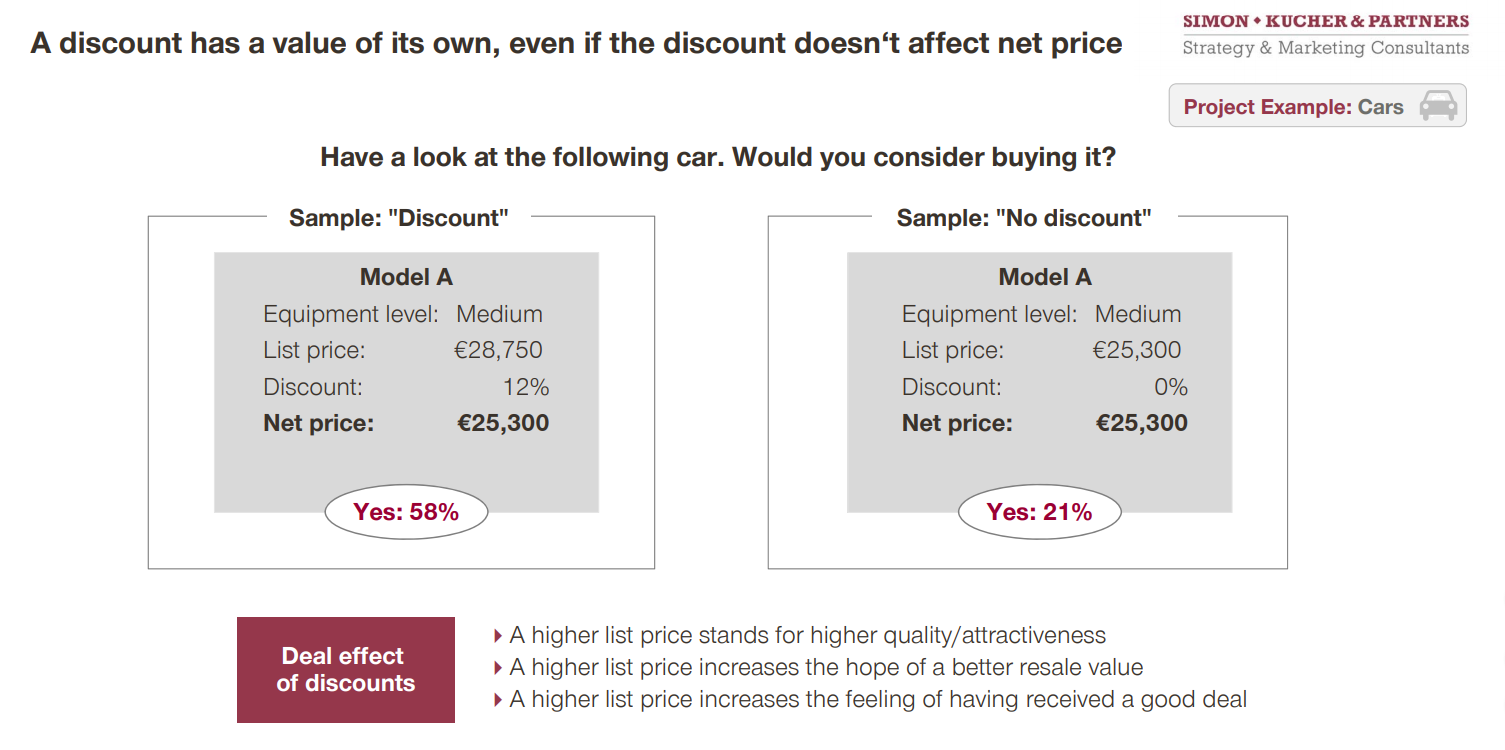
How discounts can improve price perceptions without impacting the net price.
Discounting works because there’s a deal effect as well as a quality factor at play. In uncertain or complex situations, consumers deduce the quality of a product based on the list price. Something that’s high-priced is typically also good. This works across many product categories, if the list price remains within reason.
If you want to make use of discounting as a psychological pricing tool, here are five points to consider when using discounts:
1. Choose the right discount level for your industry
What discount level is profit optimal? For this, consider two dimensions: The first dimension is what are the costs of the discount? The second dimension is what is the value to the customer of that discount? The relationship between discount level and discount value to the customer is not linear. This is illustrated by the blue line in the below project example.
We often find the value to the customer follows an S-shaped curve. Small discount levels have very little value to the customer. The same is true for additional discounts beyond a certain discount threshold. This indicates that you should aim for the discounting power zone, where you indeed, by giving a higher discount, offer significantly more value to your customer. The location of the power zone depends on your industry and product.
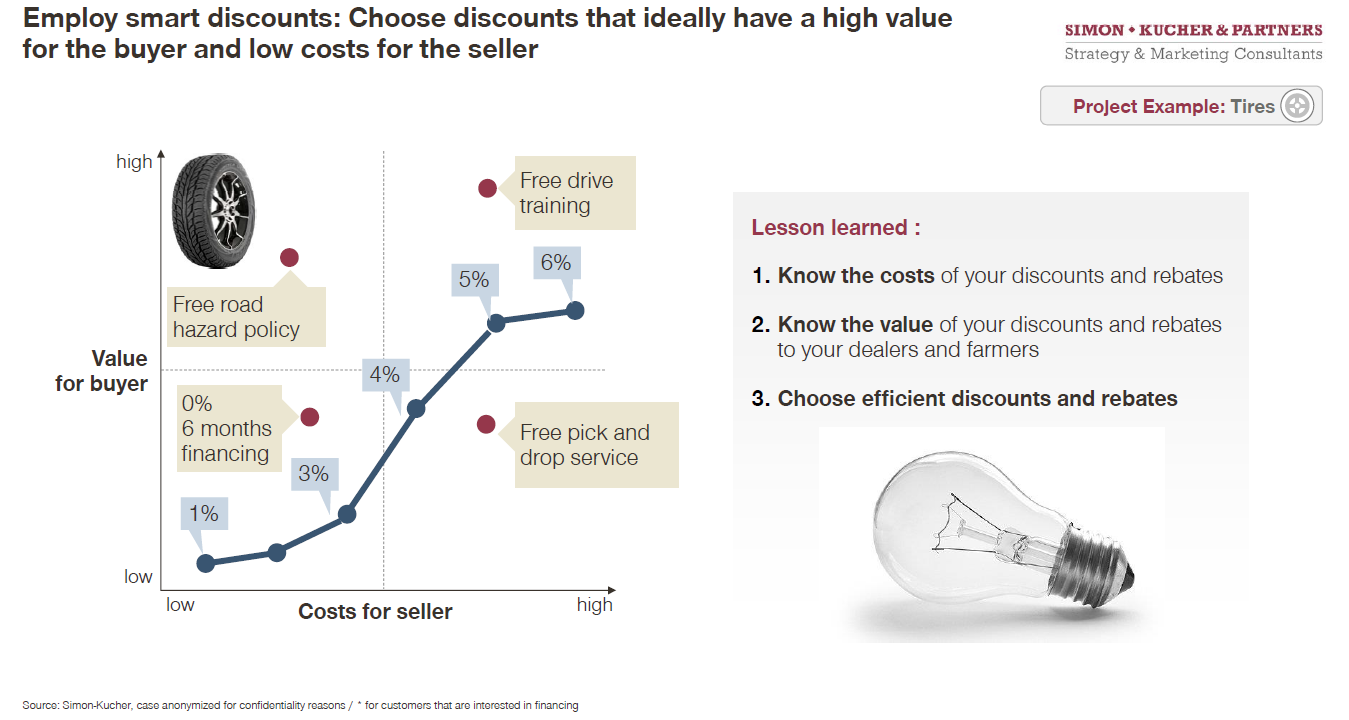
Finding the power zone of discounts.
2. Choose the right kind of discount
Discounts don’t have to be monetary. There are many types of in-kind discounts you can offer respective to your industry and product. We often find these discounts have very favorable cost-to-customer value relationships.
This is evident in the above example from the tire industry for “Free roadside hazard policy” or “0% financing”.
And discounts don’t have to be given for free. It is good practice to link discounts to your customer’s performance, e.g. deal size or cross-selling.
3. Always show the discount you’re giving your customer
As psychological pricing is about perception, how you display discounts is very important. Don’t just communicate a lower net price. Show the old price, cross it out, and show the discounted price. This rule is especially true for repeat negotiations, e.g. yearly negotiations. Don’t let negotiations start at the already discounted price leaving you little room to maneuver.
4. Discounting is not just for B2C contexts
It may be a common assumption that professional buyers don’t buy something because of a discount and the perception of a good deal.
Well, from my experience, the opposite is quite often the case. Professional buyers are addicted to discounts and the perception of having got a good deal. How would you evaluate the performance of your purchasing department if they were not able to report to their top management they had negotiated a great deal?
5. Be careful
Discounting should be handled carefully. It is the salt in the soup. A little will make your business a lot more profitable, but the wrong discounts or too much discounting will make your business less profitable.
This means: Doing market research. Finding the power zone of discounting will mean talking to your customers and conducting market tests.
And this also requires: Installing checks and balances. If unchecked, discounts have the tendency to grow over time. There have to be clear rules as to when sales teams are allowed to give discounts and when not to. And there should be clear indicators to measure the effectiveness of discounts.
The take-away
Psychological pricing is about influencing the price–value relationship your customer associates with your product or service by actively shaping price perceptions. One tool among many in this regard is discounting. Discounting helps to make prices and thus deals look more attractive. Used correctly, discounting is a very powerful tool to increase profits by achieving higher sales and/or higher prices.